Retention
New: reOtter Can Recognize Returning Customers & Show Your Reorder Widget
Your store doesn't recognize a returning customer unless they click through an email. Here's the new widget that fixes that, plus early results from two coffee brands.
Sam Schrup · November 9, 2026
Say a customer buys a bottle of hydrating face serum from you.
It's been six weeks, and at their rate of usage, they're about due for another bottle. reOtter knows this, and is already on top of triggering the customer's personalized reminder flow in Klaviyo.
But what if that customer returns to your store on their own, without clicking through an email?
Your store has no idea who they are. They'll see the same homepage as someone who's never heard of you. (Sure, you might have a lingering Klaviyo cookie to help recognize them, but if it's been more than 7 days, you probably don't.)
Our new Returning Customer Widget recognizes your past customers without depending on a browser cookie surviving.
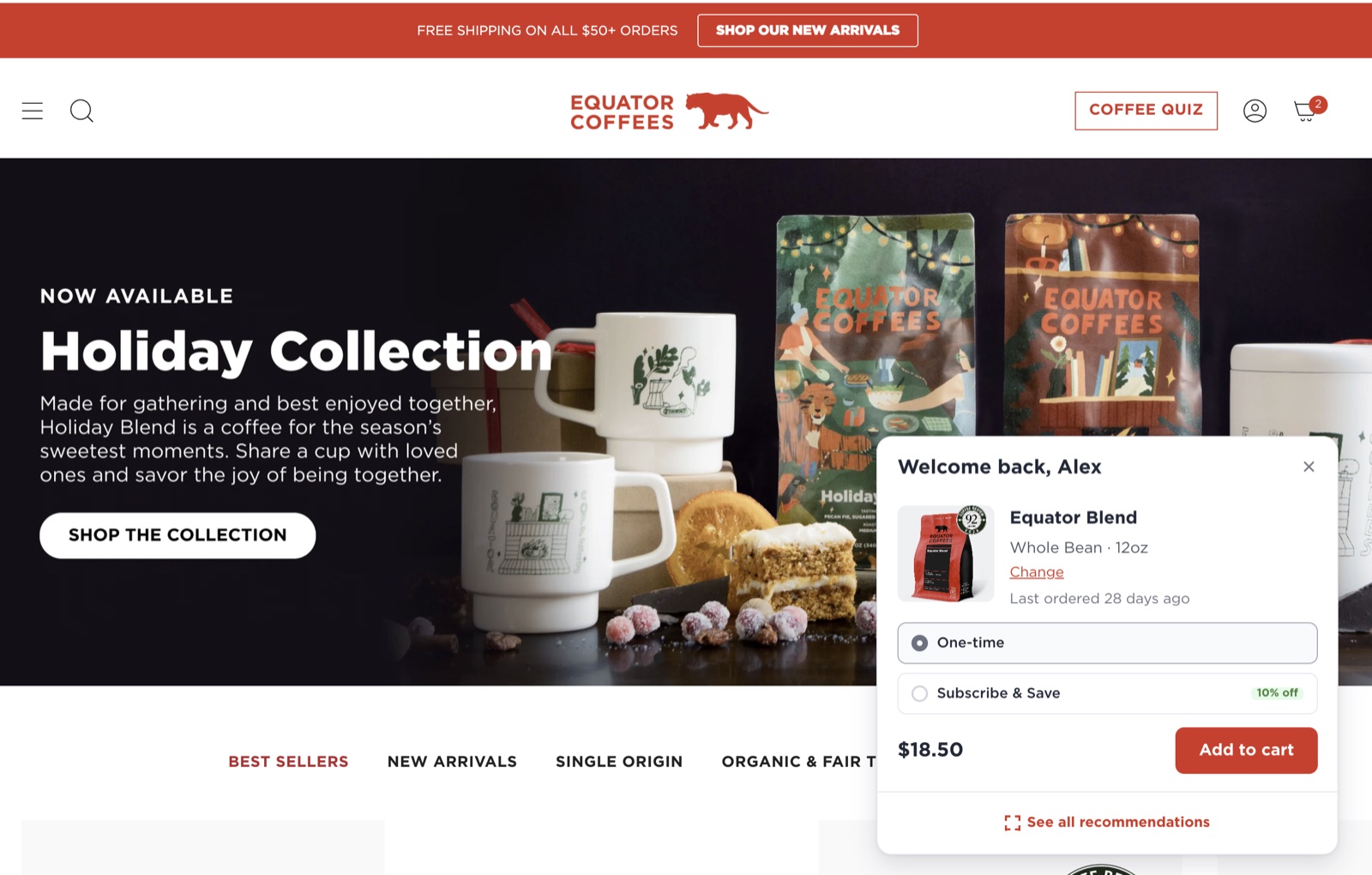
Now, when a past customer comes back on a device they've shopped on before, your store recognizes them, however they got there. A small popup shows the product(s) they're due to reorder, and allows them to add it to their cart in one click.
Here's the widget live on Equator Coffees' homepage:
Results so far
We're just rolling this out, so it's early. But two coffee brands have had the widget live for under two weeks, and we're very excited about what we're seeing.
Coffee Beanery shows the widget only to customers who are due for a reorder. In its first 11 days:
- 400 customers saw the widget
- 7% of them (28) placed an order with a product they added from the widget
- Those 28 orders came to $1,938 in product revenue, $786 of it from the widget items themselves
Equator Coffees shows the widget to every returning customer it recognizes. In its first 9 days:
- 733 customers saw the widget
- 3.8% of them (28) placed an order with a product they added from the widget
- Those 28 orders came to $2,118 in product revenue, $1,361 of it from the widget items themselves
These results are very early. We're running holdout tests, which keep a share of recognized returning customers from seeing the widget, to compare how customers behave with it versus without it. Stay tuned for an update.
What the widget does
reOtter now recognizes returning customers on the devices they've used before, regardless of how they get to your site.
When a customer is due to reorder something, a small widget shows them that SKU, with their usual size/color/preference already selected. They can add it to the cart in a single click without logging in.
When does the widget show up?
When a customer is likely running low, based on how long that product usually lasts them. (reOtter knows this.)
You decide who sees it
Brands can choose between two settings:
- Only show the widget to customers who are due for a reorder. The widget appears when there's a specific "due for reorder" product, right when the customer needs more.
- Every returning customer. The widget appears for anyone reOtter recognizes, showing what they've bought before.
Some brands love to be able to show every returning customer they've seen and recognized. But one reOtter customer said it felt too forward for their audience — so if that's you, you can turn it off.
Timing seems to matter, too. At Equator, which shows the widget to everyone, customers who were due for a reorder quick-added products at about 1.5 times the rate of other returning customers (16 quick-adds from 167 customers, vs. 36 from 570). It's a small sample, but it's the pattern we'd expect.
Less invasive than "identity networks"
Unlike other identity network tools that follow shoppers across the internet and add them to various tenuously-related lists, reOtter only recognizes your own customers on your own store. We believe you earn the right to your customers' attention, and the line between being helpful and being creepy is pretty obvious. We want to stay on the helpful side!